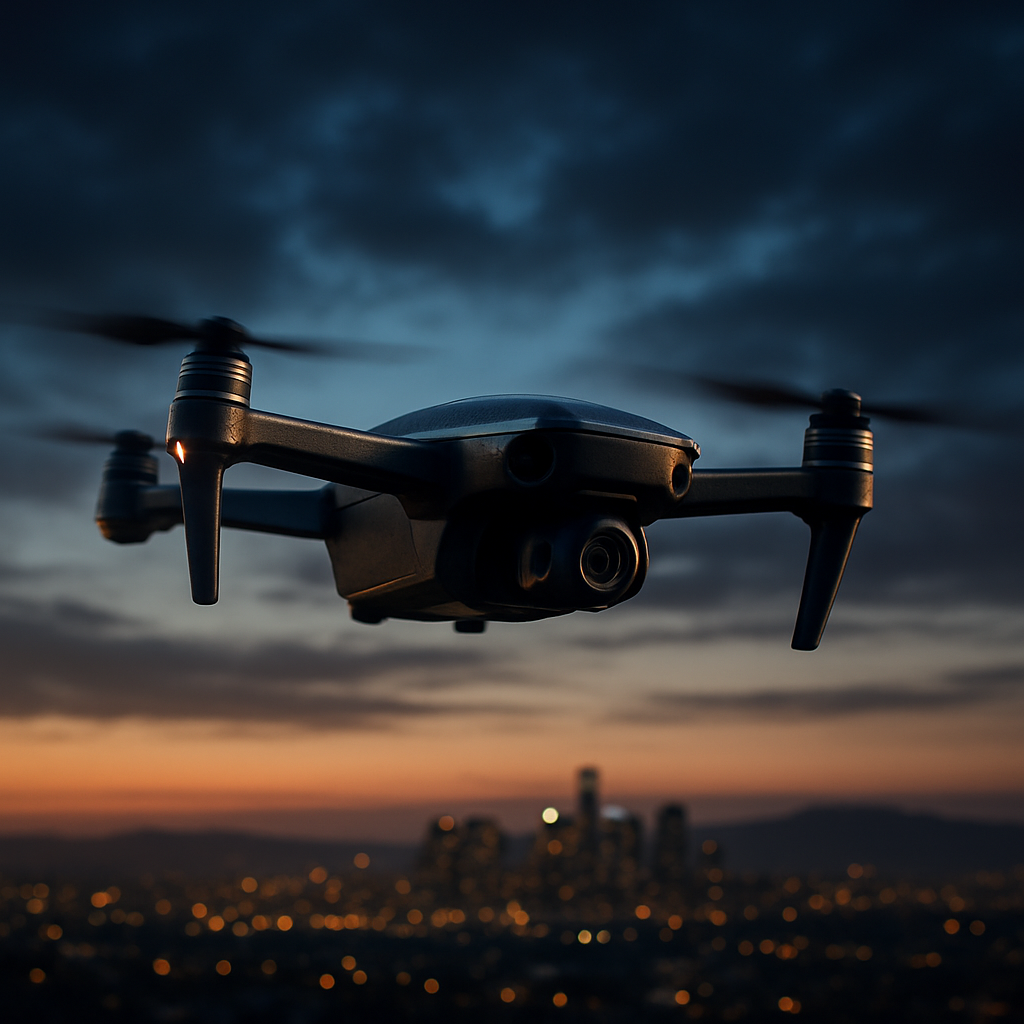
There's a tension at the heart of Silicon Valley that most tech CEOs would rather not talk about openly. On one side: the idealistic, pacifist strain of tech culture that insists the industry should keep its hands clean of military work. On the other: a rapidly shifting geopolitical reality in which autonomous technology — particularly drones — is proving to be as strategically decisive as semiconductors or AI. Skydio CEO Adam Bry isn't ducking this tension. He's walking straight into it, making a pointed and increasingly influential argument: American tech companies that self-impose red lines on drone and defense use aren't acting ethically — they're ceding the field to adversaries who face no such constraints.
This is a conversation that matters well beyond drone enthusiasts. It cuts to the core of how technology companies in democratic societies should relate to national security, geopolitical competition, and the very real-world consequences of abstention.
Who Is Adam Bry, and Why Does His Argument Matter?
At the helm of Skydio is CEO Adam Bry, an influential figure in the field of autonomy and robotics. He holds a Master's degree in Aeronautics and Astronautics from MIT, where his passion for autonomous systems was ignited — specifically through groundbreaking research at MIT's Computer Science and Artificial Intelligence Laboratory (CSAIL).
After graduating from MIT, Bry co-founded Google's Project Wing
, one of the earliest serious attempts at autonomous drone delivery.
He then co-founded Skydio in 2014, building it into the leading U.S. drone manufacturer headquartered in San Mateo, California.
Under Bry's leadership, Skydio achieved unicorn status in 2021 with a $1 billion valuation after a $170 million Series D round, and has since grown to a multi-billion-dollar company securing contracts with the U.S. Department of Defense and international partners.
As of April 2026, Skydio raised a further $110 million in Series F funding, pushing its valuation to $4.4 billion.
Bry is not just a company founder talking his own book.
He has testified before Congress on U.S. drone policy and national security, and he advocates for American leadership in aviation, ethical AI in drones, and bridging public-private partnerships to advance critical infrastructure and defense capabilities.
His voice carries weight at the highest levels of government and industry.
The Silicon Valley "Red Lines" Problem
To understand Bry's argument, you need to understand the cultural moment it's responding to. In 2018, Silicon Valley's internal politics hit a flashpoint when it emerged that Google had quietly entered into a Pentagon contract for Project Maven — an AI program designed to analyse footage from military drones.
Over 3,100 Google workers signed a letter addressed to CEO Sundar Pichai, asking him to pull the tech giant out of the project.
The letter began with the statement, "We believe that Google should not be in the business of war," and demanded that Google develop "a clear policy stating that neither Google nor its contractors will ever build warfare technology."
Google ultimately announced that the company would terminate its Project Maven work when the contract expired.
The episode set a powerful precedent — that tech employees could effectively veto national security partnerships by threatening reputational damage, attrition, and cultural disruption.
Bry sees this as a fundamental mistake. His argument, articulated across congressional testimony, podcast appearances, and public commentary, is that when capable American companies withdraw from national security work on ethical grounds, the vacuum doesn't disappear — it gets filled by others, including China.
As Bry has stated, while his focus as CEO is on products and customers, it's impossible to ignore the fact that drones represent a strategic technology as important to national security as AI and semiconductors.
Drones Are No Longer Optional — They're Essential
Bry's case isn't rooted purely in nationalism or profit motive. It is grounded in hard battlefield evidence.
After visiting Ukraine, Bry witnessed drones being used at a staggering scale — a dynamic he compared to the rapid adoption of airplanes in World War I. The range deployed includes big drones, small drones, winged drones, multirotor drones, surveillance drones, FPV kamikaze drones, and decoy drones.
As he noted, the conflict in Ukraine proved to absolute certainty that small drones are essential technology on the modern battlefield.
When speaking with executives at U.S. customers, Bry's view is that drones have proven they can be useful, but that they are on their way to becoming essential.
This isn't hyperbole.
As of November 2024, over 50% of Skydio's business was with military customers, particularly the U.S. Department of Defense, with up to 22,000 units reported in deployment.
Skydio drones are also used by allies including the UK Ministry of Defence, the Israel Defense Forces, the Indian Armed Forces, the Royal Canadian Navy, and in Ukraine.
The military utility is clear.
The Skydio X10D is designed to provide intelligence, reconnaissance, and surveillance capabilities at the platoon level, built to operate in contested environments — including conditions where GPS signals may be unavailable — using onboard navigation cameras to map terrain in real time.
The China Dimension: Why Abstention Has Consequences
Bry's argument about red lines becomes especially pointed when you factor in the competitive dynamics with China.
The United States banned DJI because it decided that the national security risk of Chinese-made drones operating across American airspace, inspecting American infrastructure, and surveilling American cities was unacceptable.
But China pushed back hard.
In fall 2024, China announced sanctions on Skydio for selling drones to Taiwan, where Skydio's only customer was its National Fire Agency.
Bry warned customers that the sanctions would result in reduced battery supply, writing that the action made clear "the Chinese government will use supply chains as a weapon to advance their interests over ours."
This is the crux of the red-lines argument. If American tech companies unilaterally disarm from the drone and defense space — whether through internal culture wars or self-imposed ethical bans — what they leave behind isn't peace. It's a landscape where
China's drone dominance deepens, with DJI alone accounting for more than 70% of global commercial drone sales.
As the CEO of the largest drone company outside of China, Bry has articulated a strong personal responsibility to meet the national security need.
From his perspective, the ethical question isn't whether to engage — it's whether American values and oversight are embedded in the technology shaping the world.
The Case That Drones Can Be a Force for Good
It's worth noting that Bry is not making an argument for unchecked or unaccountable drone use. Skydio has invested significantly in demonstrating that drone technology can serve humanitarian and civil society goals — often in ways that draw on the same technical capabilities as defense applications.
One of the most powerful examples is in Ukraine.
Skydio drones have been instrumental in gathering evidence from more than 80 shelling sites and 100 damaged civilian structures across Ukraine, enhancing the Office of the Prosecutor General's investigations by enabling safe access to hard-to-reach areas and building 3D models of war crime scenes.
In March 2024, the International Criminal Court issued indictments against two senior Russian officials based in part on evidence gathered by Skydio drones.
Skydio's products are also vital parts of critical infrastructure, revolutionising the way power plants, bridges, and roads are inspected; they're indispensable to first responders, enabling hundreds of public safety agencies to better protect their communities and officers.
Skydio became the world's first drone company to issue a set of policy and ethical principles — the Skydio Engagement and Responsible Use Principles — to guide its work and move the industry forward, capturing its commitment to considering the holistic impact on communities and countries, and conveying core values of accountability, transparency, and the protection of privacy and civil liberties.
The point Bry makes is not that there are no ethical considerations. It's that those considerations should be worked through — in public, in policy, in law, and in company principles — rather than resolved by blanket self-exclusion from entire categories of work.
Skydio's $3.5 Billion Bet on American Drone Leadership
Nowhere is Bry's conviction more dramatically demonstrated than in Skydio's April 2026 investment announcement.
Skydio announced plans to invest $3.5 billion in the United States over the next five years to expand its domestic manufacturing, accelerate R&D, and strengthen American supply chains — an investment expected to create over 2,000 new Skydio jobs, support more than 3,000 additional roles within the U.S. supply chain, and direct more than $1 billion to domestic suppliers.
The centerpiece of the investment is a new program called SkyForge, designed to expand domestic manufacturing of drone components — many of which don't currently exist in meaningful quantities in the U.S.
Rather than importing sub-assemblies and executing final assembly in the U.S., Skydio is co-locating component manufacturers inside its new mega-facility, allowing companies specialising in electric motors, silicon chips, and high-capacity battery cells to manufacture directly alongside Skydio's main assembly lines.
Skydio already manufactures more dual-use drones than any company outside of China, and has shipped more than 60,000 flying robots to more than 3,800 customers, including more than 1,200 public safety agencies throughout the country and every branch of the U.S. military.
This isn't just a business strategy. It's a direct rebuttal to the red-lines argument. If Silicon Valley steps back from drone technology — and from the defence relationships that fund its development — the global leadership in autonomous flight doesn't default to American civil society. It defaults to Shenzhen.
Practical Tips: How to Engage With the Drone Policy Debate Intelligently
Whether you're a technology professional, policy watcher, investor, or simply a citizen trying to make sense of a fast-moving debate, here's how to engage more thoughtfully:
-
Understand the difference between use-case ethics and categorical bans. Bry's argument is not that any drone use is ethical — it's that blanket prohibitions set by individual companies are the wrong mechanism. Regulatory and legal frameworks are more appropriate venues for those constraints.
-
Follow the geopolitical supply chain.
Bry's warning that China "will use supply chains as a weapon" is borne out by real events.
Understanding where drone components originate — batteries, sensors, motors — is essential for anyone evaluating the national security dimensions of this debate.
-
Distinguish between surveillance and accountability. Drones can enable mass surveillance or document human rights abuses — sometimes using identical hardware. The ethical weight lies in governance frameworks, not in the technology itself.
-
Watch the Blue UAS framework.
The Defense Innovation Unit selected Skydio as a trusted drone provider for the U.S. Federal Government under the Blue UAS program, focused on delivering cost-effective, portable, and secure systems with high standards of cyber and supply chain security.
This framework is the policy infrastructure that makes Bry's argument practically workable.
-
Track legislative developments. The FCC's December 2025 ban on foreign-made drones is reshaping the entire U.S. drone market. Understanding its implications — for competition, for supply chains, for public safety agencies — is key to following where this story goes next.
-
Engage with Skydio's ethical principles directly. Rather than relying on secondhand summaries of the debate, read Skydio's published Responsible Use Principles and evaluate whether the framework is sufficient, needs strengthening, or represents a model other defence-adjacent tech companies should emulate.
Conclusion: The Responsible Path Is Engagement, Not Abstention
Adam Bry's argument is ultimately a challenge to a certain strain of Silicon Valley idealism — the belief that the cleanest ethical hands belong to those who refuse to engage with hard questions of national security. His counter-argument is compelling: in a world where adversaries don't share your values and don't impose the same constraints on themselves, unilateral abstention is not a moral stance. It is a strategic abdication.
Bry himself has spoken about building flying robots and scaling them in high-stakes scenarios, acknowledging that when serving law enforcement and defense, the positive impact can be incredible — but there are serious ethical considerations that must be worked through.
That is not the language of someone dismissing ethics. It's the language of someone insisting that ethics be confronted head-on, not avoided.
The drone revolution is already here. The question is not whether autonomous aerial systems will reshape warfare, public safety, infrastructure inspection, and law enforcement. They already are. The real question is who builds them, under what values, with what oversight — and whether American tech companies will be at the table or watching from the sidelines as that question gets answered without them.
Want to stay ahead of the drone technology policy debate? Subscribe to our newsletter for in-depth analysis of autonomous systems, U.S.-China tech competition, and the defence-tech intersection — delivered straight to your inbox every week.