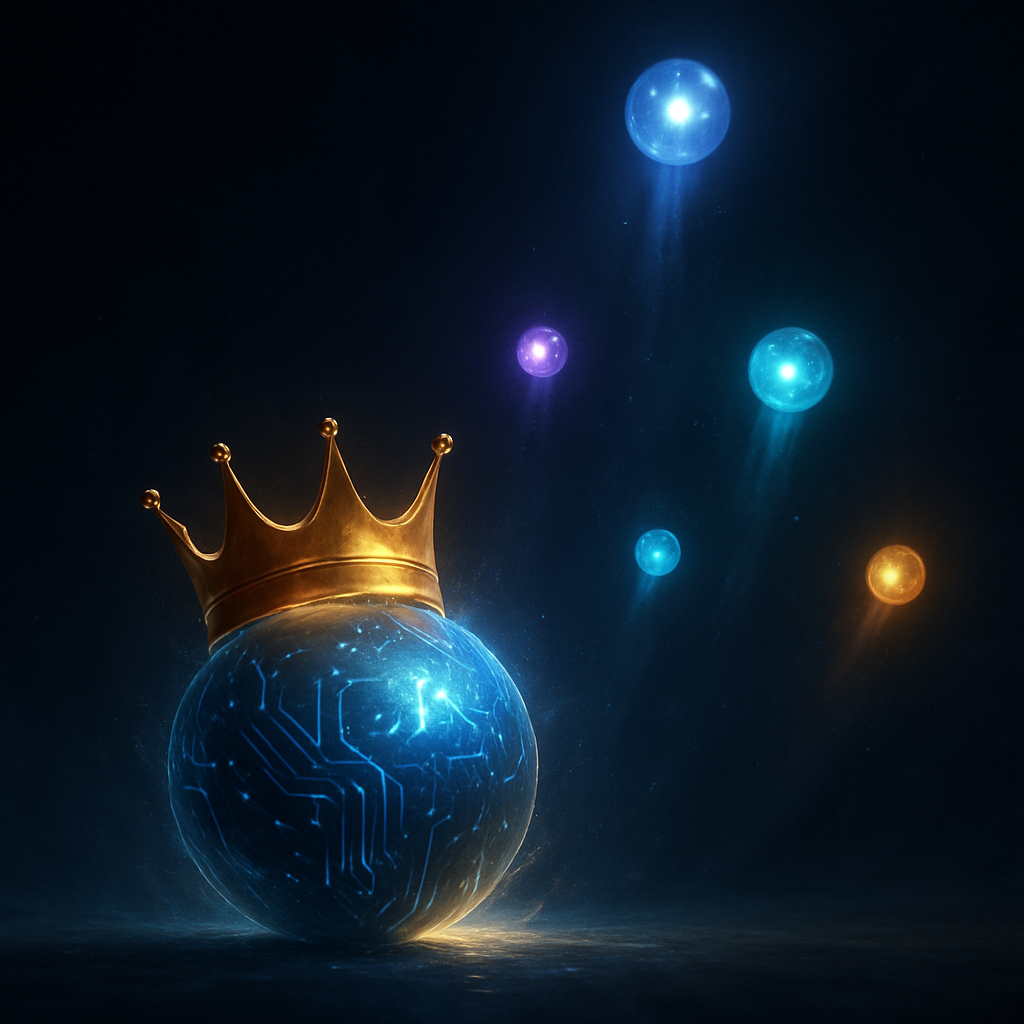
For three and a half years, ChatGPT sat atop the AI industry like an undisputed monarch. Its name became synonymous with generative AI itself — something few products ever achieve. But in 2026, the crown has slipped. According to multiple analytics firms, ChatGPT's global market share has now crossed below the 50% threshold for the first time in its history, triggering a wave of questions from users, businesses, and investors alike: Is OpenAI's reign over? Who's winning? And what does this mean for how you use AI every day?
This isn't a story about a company in crisis. It's a story about a market that has grown explosively, diversified rapidly, and matured faster than almost anyone anticipated. Here's everything you need to know.
The Numbers: How Far Has ChatGPT Fallen?
The data is striking, wherever you look.
While OpenAI's chatbot is still the most popular assistant worldwide, its market share has dipped below 50% for the first time as users are migrating to other assistants like Google's Gemini, Anthropic's Claude, and xAI's Grok, according to analytics firm Sensor Tower's State of AI Report for 2026.
On the mobile front, the decline is even sharper.
OpenAI's ChatGPT app market share fell from 69.1% in January 2025 to 45.3% in 2026, according to data from mobile intelligence provider Apptopia.
Web traffic tells a similar story.
ChatGPT's web traffic share has fallen from 87% to 56.7% in just fourteen months.
And the bleeding has continued:
ChatGPT's U.S. chatbot mobile market share has declined for four straight months, falling below 40% in March from over 50% in September 2025.
To be fair, context matters enormously here.
The chatbot still remains the most popular AI assistant worldwide with over 1.1 billion monthly users, followed by Gemini with 662 million and Claude with 245 million.
By June 2026, the ChatGPT app had reached 1 billion monthly active users, making it the fastest app in history to reach that level of scale.
So ChatGPT isn't shrinking — the market around it is simply growing far faster than it is.
OpenAI is not shrinking. It's losing ground in a category that keeps getting bigger.
Who Is Eating ChatGPT's Lunch?
The market share that ChatGPT has shed didn't disappear — it was redistributed across several fast-growing rivals, each with a distinct competitive edge.
Google Gemini: The Distribution Giant
Gemini has emerged as the most formidable challenger, and its rise isn't primarily about having a better model — it's about having an unbeatable distribution network.
The biggest growth driver is Google's ecosystem advantage: Gemini is deeply integrated into Android, Chrome, Google Search, and Google Workspace — a combination that fundamentally differentiates it from standalone chatbots like ChatGPT or Claude.
The scale of that integration is staggering.
Google Search's AI Overviews reach 2 billion monthly users across 200+ countries, appearing in up to 60% of U.S. search queries.
Gemini is available on billions of Android devices as an AI assistant — increasingly replacing Google Assistant — and is integrated into Gmail, Docs, Sheets, and Slides for Business and Enterprise plans.
In terms of raw growth,
Gemini tripled its share in 12 months — from 8.9% to 27.3% — with Google's distribution advantage at work, embedding Gemini in Search, Android, YouTube, Gmail, and Google Workspace, making every Google product a Gemini onramp.
Anthropic's Claude: The Trust and Quality Play
Claude's rise has been powered by a combination of superior output quality and a high-profile ethics moment.
Claude increased to 10% of daily active user share in March after holding less than 2% as recently as December 2025. As Apptopia's VP of Research put it: "Claude's DAU tripling in a single month looks like a step function, not a trend line."
The catalyst? A governance flashpoint.
OpenAI's deal with the U.S. Department of Defense in February triggered a measurable spike in uninstalls — suggesting brand trust and values alignment matter to users, not just features.
Claude surged to the top of Apple's U.S. App Store free app rankings, overtaking ChatGPT reportedly for the first time, while Anthropic reported record daily sign-ups, with more than 60% growth in free users since January and paid subscribers more than doubling in 2026.
But trust isn't the whole story — performance plays a role too.
Benchmarks in 2026 show Claude pulling ahead in reading comprehension, coding accuracy, and creative writing tasks, while ChatGPT still leads in some mathematical reasoning and multilingual capabilities.
Among developer communities specifically,
53% of coding professionals now use Claude as their primary AI tool.
Grok and Perplexity: The Wildcards
Don't overlook the smaller players.
Elon Musk's Grok has been growing rapidly, hitting its highest market share yet at 15.2% — up from just 1.6% at the same time last year.
Meanwhile,
Perplexity AI grew 370% year-over-year, climbing from roughly 1.2% to 5.6% of total AI chatbot traffic.
Perplexity serves a distinct but significant niche, valued particularly for research-oriented, citation-based answers.
Why Users Are Actually Switching
Market share numbers describe what is happening, but they don't fully explain why. Several forces are converging to accelerate this platform migration.
The Multi-Model Behaviour Shift
This isn't a story of users simply abandoning ChatGPT. Increasingly, they're expanding their AI toolkit.
Apptopia found that 20% of chatbot users were running at least two apps by late 2025, four times the 5% who did so two years earlier.
One in five AI users already uses multiple AI platforms, and about 79% of OpenAI users also pay for Anthropic.
This "portfolio approach" to AI reflects a growing sophistication among users who recognise that no single model excels at every task.
Ethics, Trust, and Brand Alignment
Shifting from ChatGPT to Claude signals a move toward trust-based AI selection. As switching costs drop, users are prioritising governance and data portability over UI — a transition that marks AI's evolution into infrastructure, where long-term stability and ethics are now key product features.
OpenAI's own CEO acknowledged internal alarm.
Sam Altman declared a "code red" in December 2025, pointing to a drastic strategic realignment for the company — in his own words, "we are at a critical moment for ChatGPT."
Enterprise Market Erosion
The consumer story gets even more pronounced in the enterprise segment.
OpenAI's enterprise market share has declined from 50% in 2023 to approximately 27% by the end of 2025, according to Menlo Ventures' December analysis — a downward trend that prompted urgent strategic reassessment.
In response,
OpenAI CFO Sarah Friar explicitly identified enterprise growth as a primary focus for 2026, with plans for enhanced customisation options for business clients and improved integration capabilities with enterprise software ecosystems.
The Emerging Multi-Model AI Landscape
What's forming on the other side of ChatGPT's decline isn't a new monopoly — it's something more nuanced.
The emerging structure shows three to five dominant platforms occupying distinct positions: consumer scale (ChatGPT), ecosystem distribution (Gemini), enterprise precision (Claude), social intelligence (Grok), and research search (Perplexity).
In the first half of 2026, people are on pace to download nearly 2.3 billion AI apps and spend over $4.2 billion on them, according to Sensor Tower estimates.
This is a market experiencing explosive expansion, not consolidation. The real question for users and businesses isn't which platform will "win" — it's how to navigate a permanent multi-platform reality efficiently.
Practical Tips: How to Navigate the AI Platform Shift
The good news is that this competitive fragmentation works in your favour — if you know how to use it. Here's what you can do right now.
1. Audit your actual AI use cases. Before switching platforms or adding subscriptions, document what you actually use AI for: writing, coding, research, data analysis, brainstorming, or customer interaction. Different platforms have measurable strengths for each.
Claude excels at long-form document analysis and is favoured in regulated industries, whereas Perplexity is valued for research-oriented answers; Grok thrives in social-media-driven environments with real-time data.
2. Consider a multi-model platform. Rather than paying separately for every tool,
an all-in-one AI subscription provides access to multiple AI models through a unified interface and billing system — rather than paying separately for OpenAI, Anthropic, Google, and others, users subscribe to one platform that aggregates these capabilities.
3. Match the model to the task.
The AI landscape has matured beyond the "one AI to rule them all" fallacy — different models excel at different tasks, and businesses that leverage this diversity outperform those constrained by single-vendor thinking.
Use Gemini when you need live Google integrations and large context windows, Claude when precision and document analysis matter, and ChatGPT when breadth and versatility are the priority.
4. Don't overlook Gemini if you're already in Google's ecosystem.
Gemini's free tier includes Google Search integration, image generation, Workspace integrations, and Gemini Live voice mode — and the Google integration works even without a paid plan.
If your team already uses Gmail, Docs, and Sheets, Gemini is a zero-friction upgrade.
5. Watch benchmarks, but trust real-world testing. Published scores shift constantly. Run your actual prompts across two or three platforms and compare outputs on your real deliverables.
If your workflow uses more than one model type per week, run a 30-day ROI test, using draft speed, revision rounds, and spend per deliverable as your decision metrics.
6. Factor in trust and data governance.
Shifting from ChatGPT to another platform signals a move toward trust-based AI selection — as switching costs drop, users are prioritising governance and data portability over UI.
Review each platform's data usage and privacy policies before committing sensitive business information to any single provider.
What This Means for Businesses and the Road Ahead
The market share story is ultimately a signal, not just a statistic.
This 19.2 percentage point decline in ChatGPT's dominance marks the most significant market shift in generative AI history and signals the end of OpenAI's near-monopolistic position — revealing a rapidly evolving competitive landscape where distribution advantages, ecosystem integration, and continuous innovation are displacing first-mover advantages.
For businesses, the practical implication is clear:
organisations locked into single AI vendors face strategic risk as market dynamics evolve rapidly.
Building a flexible, multi-platform AI strategy is no longer a luxury — it's basic risk management.
Conclusion: The Multi-Model Era Is Here — Are You Ready?
ChatGPT falling below 50% market share is less a story about OpenAI's failure and more a story about how fast the AI landscape has matured. What was once a single-horse race is now a dynamic, competitive ecosystem where Google's distribution muscle, Anthropic's ethical positioning, and a dozen nimble challengers are all competing for your attention and your workflows.
The winners in this new era won't be the users who find the "best" AI platform and stick to it loyally — they'll be the ones who build smart, flexible, multi-model strategies that match the right tool to the right task. The AI platform shift is no longer coming. It's already here.
Ready to future-proof your AI strategy? Subscribe to our newsletter for weekly breakdowns of the latest AI platform updates, model comparisons, and productivity guides — delivered straight to your inbox. Don't let the next market shift catch you off guard.