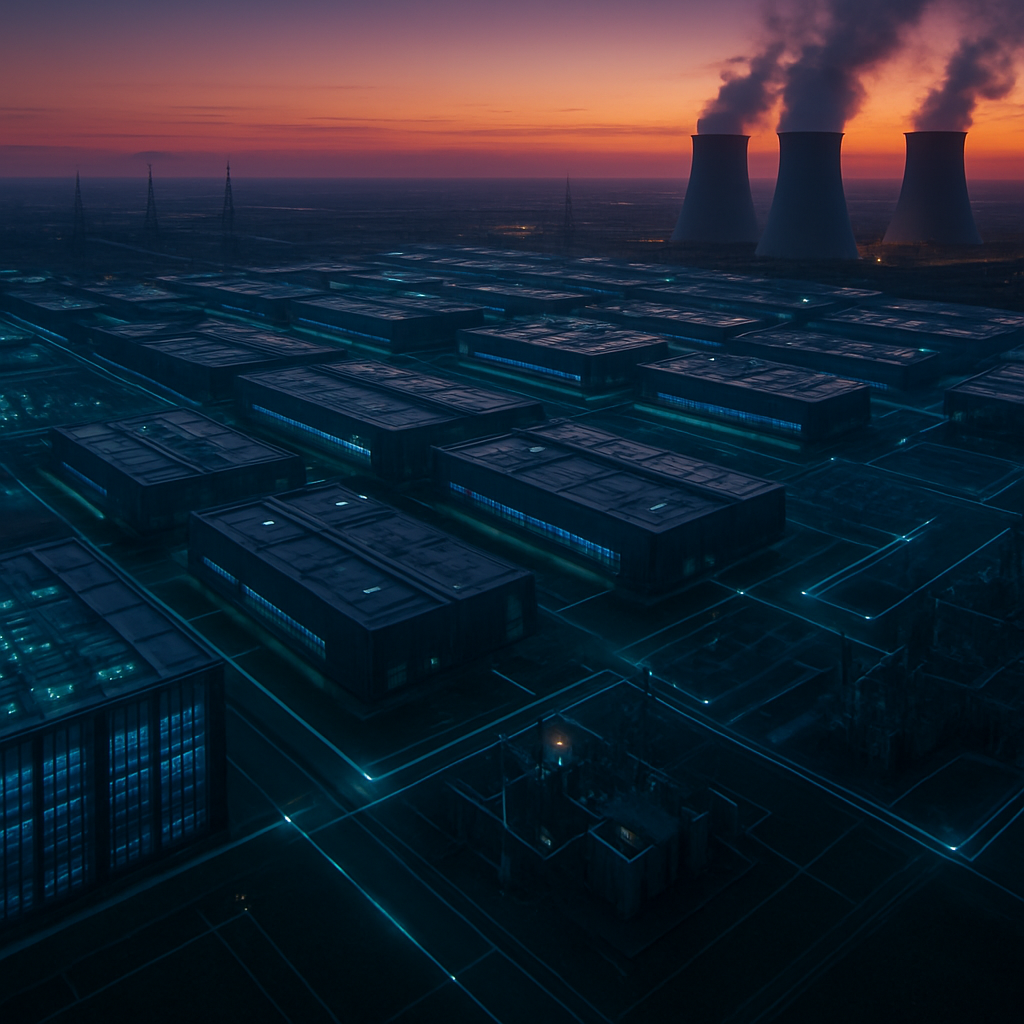
The numbers are in — and they are staggering. By 2027, AI-optimised servers will consume more electricity than every conventional server on the planet combined. That's not a distant hypothetical. It's a forecast backed by Gartner, Goldman Sachs, the IEA, and a growing chorus of energy analysts who are watching AI's appetite for power reshape the global energy landscape in real time. For IT infrastructure leaders, this isn't just an energy story — it's a strategic planning crisis hiding in plain sight.
If you're responsible for data center operations, IT infrastructure strategy, or technology procurement, the 2027 horizon demands your attention right now.
The 2027 Inflection Point: What the Data Actually Says
The scale of what's coming is almost difficult to process.
AI-optimised servers consumed approximately 95 TWh worldwide in 2025 and are forecast to draw 175 TWh in 2026 — an increase of roughly 84%. Gartner expects that figure to reach 258 TWh in 2027, the point at which AI-optimised hardware will consume more electricity than conventional servers for the first time.
Meanwhile,
conventional servers have remained effectively flat by comparison, growing less than 1% in 2025 and projected to reach only around 200 TWh in 2027.
The US picture is equally dramatic.
US data center power demand is forecast to more than double to 66 GW in 2027 from 31 GW in 2025, driven by an accelerating buildout of AI infrastructure, according to Goldman Sachs Commodities Research.
And
data centers' share of total US peak summer power demand is projected to jump to 8.5% in 2027 from 4.1% in 2025, creating significant tightening across the national power market.
Looking further ahead,
Gartner forecasts global data center electricity consumption to reach 565 TWh in 2026, up from 447 TWh in 2025
, with
global data center electricity use projected to top 1,200 TWh by 2030.
The trajectory is clear: the AI power surge is not slowing down — it's accelerating.
Why AI Workloads Are So Energy-Intensive
To understand the infrastructure challenge, you need to understand why AI is so much hungrier than the workloads that came before it.
AI data centers require 30 to over 100 kilowatts per optimised rack compared to 5–15 kilowatts for traditional infrastructure.
That's a power density increase of up to 20 times in a single rack footprint.
For larger hyperscaler data centers optimised for AI workloads, servers include chips that consume 2–4 times more watts than their conventional counterparts.
At scale, those watts multiply fast.
One analysis found training certain large models now consumes 50 gigawatt-hours — enough to power San Francisco for three days.
The global electricity demand of data centres grew by 17% in 2025 overall, but electricity consumption from AI-focused data centres grew even faster, surging 50% in 2025.
Efficiency improvements in hardware are real, but
new servers do pack more computation per watt — yet explosive growth in AI training and inference workloads consistently outruns those improvements.
Cooling is also a major — and often under-discussed — factor.
Electricity used by cooling systems is forecast to climb 22.6% in 2026 to 195 TWh, reflecting the thermal load of denser AI racks and continued capacity expansion.
Grid Constraints Are Already Becoming a Strategic Bottleneck
Here's the part that should keep infrastructure leaders up at night: the grid simply wasn't built for this.
Electricity demand is rising faster than the US power grid — much of it built decades ago — was designed to handle.
More than 75 data center projects worth $130 billion were blocked in the first months of 2026 amid opposition over power and water costs, while some operators have turned to on-site gas generators to bring capacity online without waiting for grid connections.
Gartner warns that grid supply will be insufficient to meet demand once consumption passes 1,200 TWh by 2030 — a shortfall that will affect all data center users, not just AI operators.
The construction pipeline itself faces delays.
Only about 50–60% of data center capacity scheduled for the next one to two years is expected to come online on time amid delays and cancellations.
Supply chain and labor shortages remain the most common causes of delay, and the typical data center takes 18 to 24 months to build once permits are secured.
AI companies are clamoring for gigawatts of new capacity in a few years, but current permitting processes for new power plants and high-voltage transmission lines can take over a decade in the US and EU.
That mismatch between computing speed and energy infrastructure timelines is one of the defining tensions of the current era.
Regional Risks Are Not Created Equal
Not all markets face the same exposure to this power crunch, and IT infrastructure planners need to think regionally, not just globally.
There are sharp regional differences in Goldman Sachs Research's outlook. In 2027, the average annual data center additions in each of the Mid-Atlantic, Texas, and Mid-Continent power markets are individually scheduled to exceed the entire nation's total additions in 2025. Power reliability risks are elevated in the Mid-Atlantic, Mid-Continent, and Northwest markets because planned generation capacity additions are limited relative to the incoming flood of data center demand.
Regional impacts will diverge sharply, with Mid-Atlantic, Mid-Continent, and Northwest markets facing elevated reliability risks, while the impact in Texas and Georgia may be relatively marginal thanks to plans for additional power generation.
This means where you locate or contract data center capacity matters enormously — not just for cost, but for operational continuity.
How Hyperscalers Are Responding (And What It Means for Everyone Else)
The largest tech companies are not sitting still.
The largest technology companies saw capital expenditure exceed USD 400 billion in 2025 — and that figure is expected to jump by another 75% in 2026.
Hyperscalers have moved aggressively toward alternative power sources, with Meta having signed deals for more than 6 GW of nuclear power to supply its upcoming data centers, and one firm repurposing retired US Navy reactors for an AI site in Tennessee.
However,
those projects will take years to deliver, with recommissioned nuclear plants and the earliest small modular reactors not expected online until 2028 or later.
Developers expect power constraints by 2027–2028 due to underinvestment in grids and potential supply chain disruption. Off-grid is rising, with natural gas, microgrids, batteries, nuclear and hybrid systems gaining momentum as data centers effectively "bring their own power."
For enterprises that aren't hyperscalers, this signals a shift in vendor selection criteria: energy security and power sourcing strategy need to become part of your colocation and cloud provider due diligence process.
Practical Tips for IT Infrastructure Leaders: What to Do Right Now
The 2027 forecast isn't something to simply monitor — it requires proactive planning decisions today. Here's what infrastructure and operations leaders should be doing immediately:
- Conduct a power capacity audit. Review your current data center PUE (Power Usage Effectiveness) and identify inefficiencies before capacity constraints force the issue.
Infrastructure and operations leaders must prioritise efficiency upgrades and secure grid access, and also invest in high-efficiency cooling systems and edge computing to mitigate power constraints and ensure sustainable, scalable growth.
- Interrogate your colocation and cloud providers on energy sourcing. Ask your providers directly: where does their power come from, what are their grid connection queues, and do they have backup generation plans?
Around 20% of planned data center projects globally could be at risk of delays due to grid strain
— you need to know if yours is one of them.
- Model your AI workload energy footprint. If you're scaling AI inference or training workloads, map their power requirements explicitly.
Electricity consumption in accelerated servers is projected to grow by 30% annually in the base case, while conventional server electricity consumption growth is much slower at 9% per year
— AI workloads are not equal to general IT workloads in energy terms.
- Explore liquid cooling and immersion cooling technologies.
The share of cooling systems in total data centre consumption varies from about 7% for efficient hyperscale data centres to over 30% for less-efficient enterprise data centres.
Migrating to more efficient cooling architectures can meaningfully reduce your total power draw.
-
Build geographic diversification into your infrastructure strategy. Given the regional power risks highlighted by Goldman Sachs and others, distributing workloads across regions with different power profiles — and different grid stability outlooks — provides resilience against localised outages and price spikes.
-
Lock in Power Purchase Agreements (PPAs) early.
PPA prices rose by an average of 35% in 2024, driven largely by the surge in procurement from large AI developers.
The longer you wait, the more expensive and harder to secure these agreements will become.
- Embed energy planning into your AI project governance. Every significant AI initiative should include an energy cost and availability assessment as part of its business case — not as an afterthought, but as a foundational input.
Conclusion: Power Security Is the New IT Strategy
The 2027 AI power consumption forecast is a watershed moment for IT infrastructure planning. The days of treating data center electricity as a predictable, background operational expense are over.
As Gartner's Director Analyst put it, "AI capacity is now constrained by power availability, making data center power security the new battleground for scaling and protecting margins in the global AI race."
The organisations that will win the next phase of AI-driven competition are not just those with the best models — they're the ones that secure reliable, affordable, and sustainable power before the grid tightens further.
The window for proactive planning is narrowing. Infrastructure leaders who treat energy strategy as a first-class IT concern in 2026 and 2027 will have a meaningful competitive advantage. Those who don't risk finding their AI ambitions constrained not by talent or budget, but by kilowatts.
Ready to future-proof your IT infrastructure for the AI power era? Start by auditing your current energy dependencies and engaging your technology partners in an honest conversation about power security. The 2027 inflection point is closer than it looks — and the time to plan is now.